

Why Secondary Medical Insurance Is Growing in Alabama
Health insurance costs continue to put pressure on Alabama employers.
For groups effective October 1, 2026 and beyond, Providence Benefits received guidance that Alabama's dominant health insurance carrier increased its maximum rate increase cap from 25% to 50%.
That does not mean every group will receive a 50% increase. It does show how much the health insurance environment has changed.
According to KFF, the average annual premium for employer sponsored family coverage reached $26,993 in 2025. That was up 53% from 2015. The average deductible for workers with single coverage and a deductible reached $1,886.
As primary insurance becomes more expensive, brokers and employers are looking for other ways to control costs. One strategy that has become increasingly common in Alabama is Secondary Medical Insurance, also known as Major Medical GAP Insurance.
What Is Secondary Medical Insurance?
Secondary Medical Insurance works alongside an employer's primary health plan.
A common strategy is to move the employer to a primary plan with a higher deductible or higher out of pocket exposure. The employer then adds a secondary medical plan designed to cover some of that additional exposure.
The difference in primary plan premium can sometimes be greater than the cost of adding the secondary coverage. That is where the savings opportunity comes from.
At Providence Benefits, the goal is simple.
Lower the employer's total health care cost without asking employees to accept worse benefits.
Why Is Secondary Medical Insurance So Popular?
There are three major reasons employers and brokers continue to use this strategy.
1. Lower the Cost of the Premium
The first reason is cost.
Moving to a higher deductible primary health plan can create significant premium savings. Secondary Medical Insurance can then be added to help cover some of the additional exposure created by that move.
For example, we recently worked with a company enrolled in Blue Cross and Blue Shield of Alabama’s Silver plan. The plan had a $4,200 deductible and cost $580.75 per month.
Providence Benefits proposed moving the group to the Blue Saver Bronze plan and pairing it with GAP coverage.
The Bronze plan cost $401.22 per month. The GAP plan cost $151.59 per month. Together, the total monthly premium was $552.81.
That reduced the company’s overall premium by about 5% while lowering the employee deductible from $4,200 to $750.
As a rule of thumb, employers do not implement the strategy unless the numbers make sense.
The purpose is not simply to add another insurance product. The goal is to reduce the overall cost of the health plan.
2. Compare Claims With and Without GAP
Saving money is only part of the equation.
We also compare how employee claims would be paid under the current plan against how those same claims could be paid under the proposed primary plan with GAP coverage.
A lower premium does not provide much value if employees are left with significantly higher medical expenses. That is why the claims analysis is so important.
Below is one claims example Providence Sent the Group above, comparing Bronze + Gap to BCBS Saver Gold.
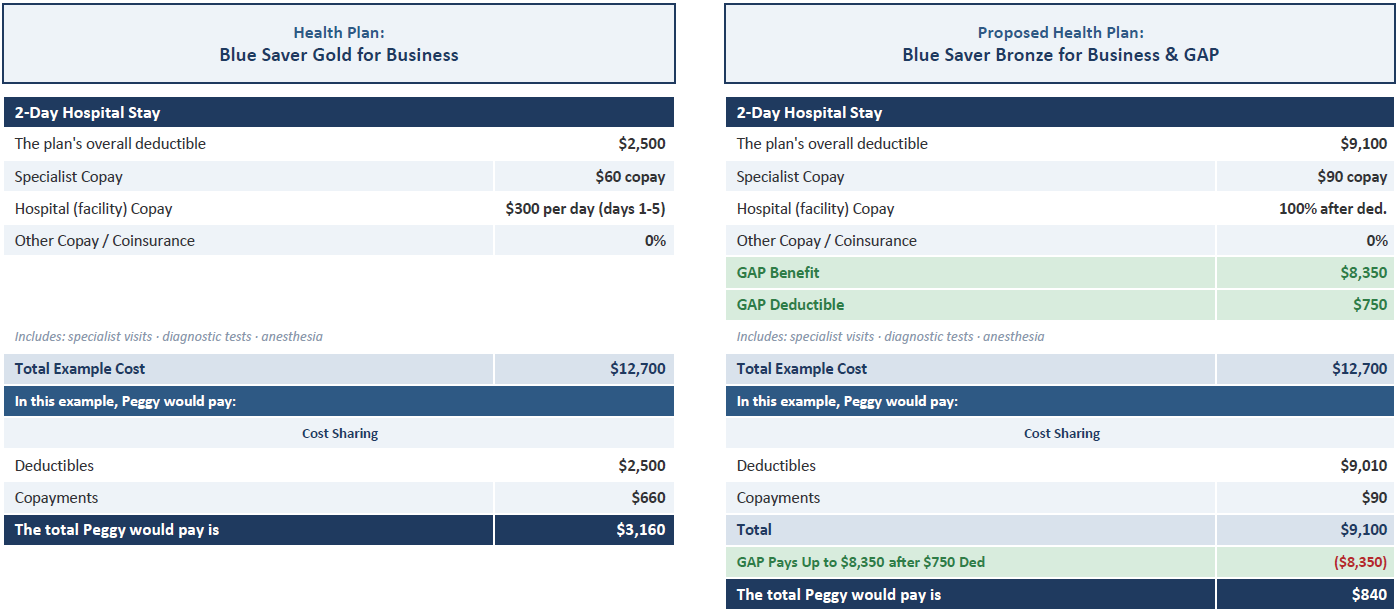
In the groups we analyze, the objective is to provide comparable or improved benefits while reducing the employer's overall health care cost.
When a strategy can save the employer money without asking employees to accept worse benefits, it becomes much easier to understand why Secondary Medical Insurance has become so popular.
3. Rate Stability
Rate stability may be one of the biggest advantages of Secondary Medical Insurance in today's market.
Primary medical plans can experience significant renewal increases. Secondary coverage can sometimes be much more stable.
Based on Providence Benefits' experience with our own book of business, we estimate that roughly 85% of our GAP renewals receive a rate hold. That can help soften the impact of an increase on the primary plan.
For example, one Providence Benefits group received a 28% increase on its primary medical coverage. Its GAP coverage received no increase. When the two costs were combined, the group's overall increase was approximately 21%.
The primary plan still increased. But the stability of the secondary coverage helped reduce the overall impact. As large primary plan increases become more common, that stability can make the overall health care strategy more sustainable.
What About HSA Plans?
Health Savings Accounts are another option brokers and employers may consider when trying to manage higher deductibles.
HSAs can be an excellent fit for many employees. They offer tax advantages and allow employees to build funds that can be used for qualified medical expenses.
But the strategy works best when employees have enough disposable income to consistently fund the account.
Recent federal data shows why that can be difficult for some households. In 2025, 39% of adults said the largest emergency expense they could cover using savings was less than $1,000. Thirty percent said they could not cover three months of expenses through savings, borrowing or selling assets.
HSA contribution data also shows a relationship with income. Congressional Research Service analysis of IRS data found that higher income groups were generally more likely to report HSA contributions and tended to contribute larger amounts.
That does not make an HSA a bad strategy. It means brokers should consider whether employees will realistically have the money available when a large deductible comes due.
Secondary Medical Insurance takes a different approach. Instead of relying entirely on employees to save enough money to cover future expenses, the insurance benefit can help cover eligible costs when a claim occurs.
Why Secondary Medical Insurance Continues to Grow
There is no single health insurance strategy that works for every employer. But Secondary Medical Insurance continues to receive attention for a few simple reasons.
It can create savings when moving to a higher deductible primary plan. It can help employers maintain comparable employee benefits. It can also add a more stable piece to an overall health insurance strategy when primary premiums are increasing quickly.
The key is running the numbers.
At Providence Benefits, we provide brokers with a cost and claims analysis before recommending a strategy. This allows the broker and employer to see how the proposed plan compares with their existing coverage before making a decision.
See What Secondary Medical Insurance Could Do for Your Group
If you are a broker with a group facing a difficult renewal, send it to Providence Benefits.
We can compare the current plan against alternative primary and Secondary Medical Insurance strategies. We will show the employer cost and how employee claims could be affected.
There is no charge for the analysis.
The numbers can determine whether the strategy makes sense for the group.
Visit ProvidenceBenefits.com or contact Providence Benefits to request an analysis.
Comments (0)